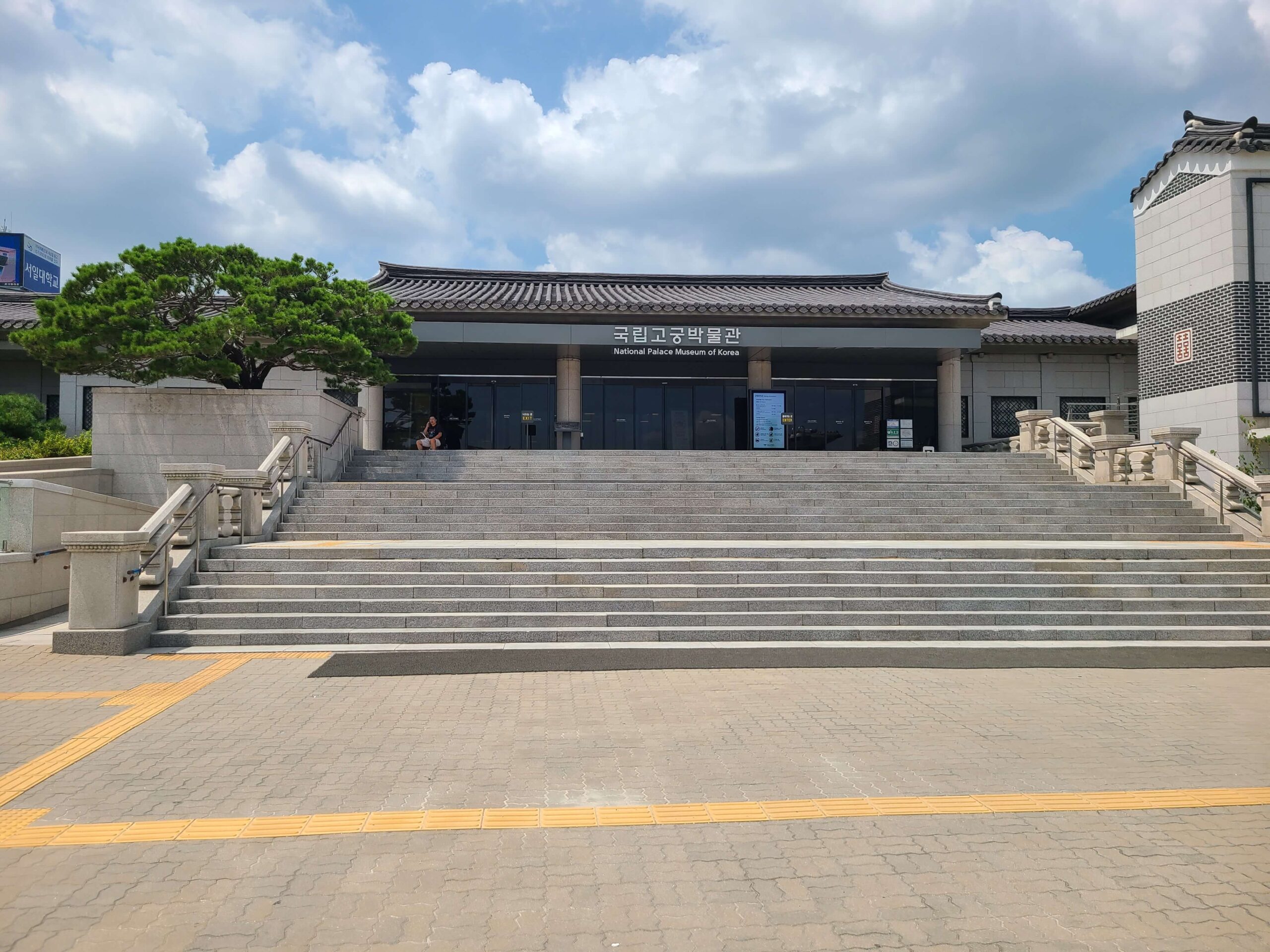
Quick Information – 국립 고궁박물관
- Location: Next to Gyeongbokgung Palace, Jongno-gu, Seoul
- Admission: Free
- Opening Hours: 9:30 AM–5:30 PM
- Saturday: 9:30 AM–9:00 PM
- Last Wednesday of each month: Open until 9:00 PM
- Last Admission: 30 minutes before closing
- Recommended Visit Time: About 1–2 hours
- Main Exhibitions: Joseon kings, royal family life, royal rituals, royal art, science, astronomy, and the Korean Empire
- Good For: Families, children, first-time visitors, and travelers interested in Korean history
- Best Route: Gyeongbokgung Palace → National Palace Museum of Korea
- Indoor Attraction: Good for hot, cold, or rainy days
- Admission Fee: Free


The National Palace Museum of Korea is located right next to Gyeongbokgung Palace and introduces the history and culture of Korea’s royal court.
I visited with my children after exploring Gyeongbokgung Palace.
At Gyeongbokgung, we saw the actual spaces where Joseon kings and the royal family lived and governed. At the museum, we could learn more about the objects they used, royal ceremonies, food, science, astronomy, calendars, and timekeeping.
My children were more curious than I expected and asked many questions while looking at the exhibits.
If you are visiting with children, learning a few basic facts about the Joseon Dynasty beforehand can make the museum much more interesting.
✔ Google Maps
👉 National Palace Museum of Korea – Next to Gyeongbokgung Palace
Why Visit After Gyeongbokgung Palace?
Gyeongbokgung Palace and the National Palace Museum of Korea are best experienced together.

Gyeongbokgung lets you walk through the actual royal palace, while the museum helps explain how the people inside the palace lived and how the royal court operated.
After seeing the palace buildings, objects such as royal seals, ceremonial items, scientific instruments, paintings, and objects from royal daily life become easier to understand.

For first-time visitors interested in Korean history, I recommend visiting Gyeongbokgung first and entering the museum afterward.
Understanding the Museum by Floor
One thing to remember before exploring the museum is that each floor focuses on different periods and themes.

2F – Joseon Kings and Royal Life
The second floor focuses mainly on the Kings of the Joseon Dynasty and Life in the Royal Family.
Visitors can see objects associated with Joseon kings and members of the royal family and learn more about life inside the palace.
Royal seals are particularly interesting.
The royal family used different types of seals, including official and personal seals. Seeing these small objects provides a more personal view of people who are usually introduced simply as kings and historical figures.

There are also exhibitions related to royal food and everyday palace life.

Large displays of royal meals are easy to understand visually and were particularly interesting for my children.
They helped us imagine that Gyeongbokgung was not simply a collection of beautiful buildings. It was once a place where people actually lived, ate, worked, and raised families.
1F – The Korean Empire
The first floor introduces the Korean Empire, taking visitors forward from the Joseon period toward Korea’s modern era.

This section shows how the royal court changed during a period when Korea was encountering new technologies and attempting to modernize.
Royal vehicles and objects associated with the imperial family are among the displays visitors can see here.
After seeing traditional Joseon royal culture, the differences in this section are noticeable.
It provides an important connection between the Joseon Dynasty and Korea’s modern history.
B1F – Royal Rituals, Art and Science
The basement level covers several major themes:
- Paintings and Calligraphy of the Joseon Royal Court
- Royal Rituals of the Joseon Dynasty
- Scientific Achievements of the Joseon Dynasty
For me, this was one of the most interesting parts of the museum.
Royal Rituals of the Joseon Dynasty
Royal ceremonies were an important part of the Joseon court.
They followed established procedures and involved specific clothing, food, music, decorations, and ceremonial objects.


The museum displays various objects used in royal rituals and recreates parts of ceremonial settings.
The large and colorful displays are also visually interesting for children.
These exhibits helped us understand that the palace was not simply the king’s residence.
It was also an important political and ceremonial space.
Science, Astronomy and Time in Joseon
One of the exhibitions I found particularly interesting was the section about science and astronomy during the Joseon Dynasty.
Joseon developed knowledge and instruments related to astronomy, calendars, timekeeping, weather, and measurement.
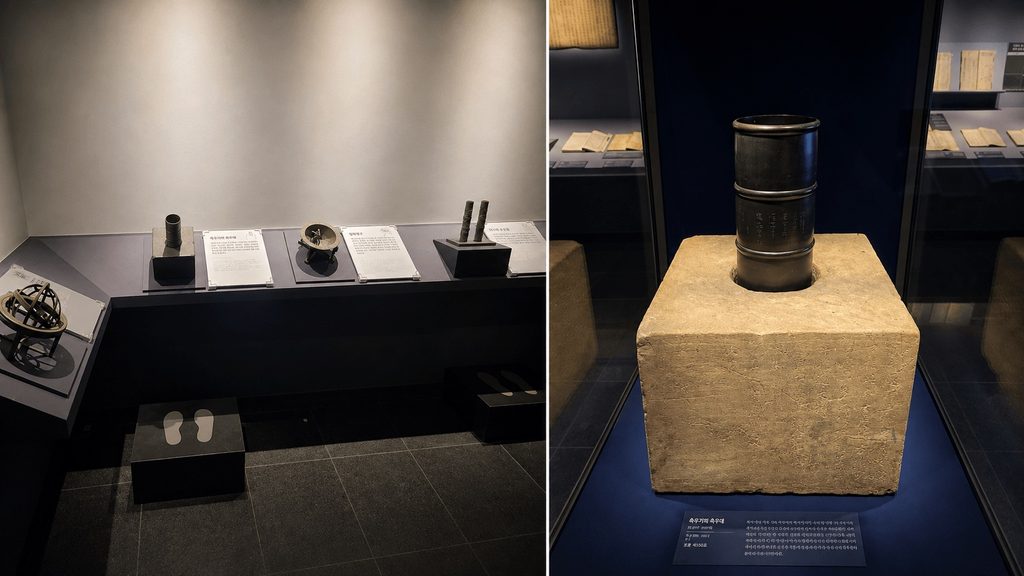
The Cheonsang Yeolcha Bunyajido, an astronomical chart representing constellations, is one of the interesting subjects introduced here.
Joseon society was largely based on agriculture.
Because of this, understanding the seasons and maintaining accurate calendars had practical importance.
Astronomy and timekeeping were connected not only with scientific knowledge but also with agriculture and government administration.
Looking at these exhibits helped me understand why time, seasons, and calendars were so important during the Joseon period.
Astronomy at the Royal Court
The museum also explains how astronomy was studied and recorded by the royal government.
Astronomical observations were used in connection with calendars and the measurement of time.

Books, charts, records, and scientific materials show how this knowledge was accumulated.
For foreign visitors, this section provides another perspective on Joseon history.
The period was not only about kings, palaces, and wars.
Science, observation, measurement, and detailed record keeping were also important parts of Joseon society.
Open Storage
Another interesting area is the museum’s Open Storage.
Here, visitors can see many royal objects displayed together rather than only a few selected artifacts.
It gives a sense of the variety of objects preserved by the museum and also provides a look at how cultural heritage is stored and managed.
For children, simply seeing so many historical objects together can be an interesting experience.
Visiting With Children
I visited the museum with my children, and they were surprisingly interested.
They looked closely at the exhibits and asked questions about royal food, ceremonies, seals, scientific instruments, and other objects.
For families, I think it is helpful to explain a few simple ideas before visiting:
Who was the king?
What was Gyeongbokgung Palace used for?
Why were royal ceremonies important?
Why did people observe the stars and seasons?
You do not need to give children a full history lesson.
Even a little background knowledge can help them connect the palace they just visited with the objects inside the museum.
A Seoul Route for Understanding Korean History
If you want to understand Korean history rather than visit each attraction separately, I recommend this route:
Gyeongbokgung Palace → National Palace Museum of Korea → Seodaemun Prison History Hall → Deoksugung Palace
Gyeongbokgung Palace
Start with Gyeongbokgung to see one of the most important royal palaces of the Joseon Dynasty.
Walking through the palace provides the physical background for what you will see inside the museum.
National Palace Museum of Korea
Next, visit the museum to learn about Joseon kings, royal life, ceremonies, science, astronomy, and the Korean Empire.
The museum adds historical context to the palace buildings you have just seen.
Seodaemun Prison History Hall
Seodaemun Prison History Hall moves the journey into Korea’s modern history.
It introduces the period of Japanese colonial rule and the Korean independence movement.
Deoksugung Palace
Together, these places provide a useful historical sequence:
Joseon Dynasty → Korean Empire → Japanese colonial period → modern Korean history
It does not cover every part of Korean history, but for first-time visitors it provides a clear introduction to several important periods.
Practical Tips
Because the museum is directly beside Gyeongbokgung Palace, I recommend visiting both on the same day.
Admission to the museum is free.
Most of the exhibitions are indoors, making the museum especially useful during Seoul’s hot summer, cold winter, or rainy weather.
If you are visiting with young children, do not feel that you need to see every single artifact.
We found it more enjoyable to stop at exhibits that interested the children and answer their questions as we walked around.
Allow about 1–2 hours for a comfortable visit.
Nearby Places
1. Gyeongbokgung Palace
Located right next to the museum and the best place to explore the history and architecture of the Joseon royal court.
Best Things to Do Near Gyeongbokgung Palace – Hidden Food Spots & 1 Day Seoul Itinerary (2026)
2. Jongmyo Shrine
A historic royal shrine where memorial rituals were held for the kings and queens of the Joseon Dynasty.
Best Things to Do in Jongno – Traditional Royal Ceremony at Jongmyo Shrine
3. Gwangjang Market
One of Seoul’s famous traditional markets, known for Korean street food and a lively local atmosphere.
Best Food in Gwangjang Market – 5 Must-Try Spots Near Gyeongbokgung
4. Seodaemun Prison History Hall
A historic site where visitors can learn about Korea’s modern history and independence movement.
Things to Do in Seoul – Seodaemun Prison & Korea’s Independence History
5. Changdeokgung Palace
A UNESCO World Heritage palace known for its traditional architecture and beautiful Secret Garden.
Changdeokgung Secret Garden Walk – Thing to Do Near Gyeongbokgung Palace
Places to Eat After Your Visit
1. Meokseongjip
A local Korean restaurant where you can enjoy a simple and filling Korean meal after visiting the museum.
Best Korean BBQ in Jongno – 3 Must-Try Pork Belly Spots in Ikseon-dong
2. Unlimited Galbi & Samgyeopsal
An all-you-can-eat Korean BBQ restaurant where you can enjoy galbi and samgyeopsal at an affordable price.
$15 Korean BBQ Buffet in Jongno Near Gyeongbokgung Palace – All-You-Can-Eat
3. Oyster Bossam
A Korean restaurant specializing in oyster bossam, served with fresh oysters, tender boiled pork, kimchi and side dishes.
Best Oyster Bossam Restaurant in Jongno – Must-Try Korean Food in Seoul
4. Cheese Dakgalbi
Spicy stir-fried chicken with vegetables and melted cheese, a popular Korean dish for sharing.
10 Best Restaurants in Jongno, Seoul: Must-Try Dakgalbi & Korean Food Near Gyeongbokgung Palace
5. Dakhanmari
A traditional Korean whole-chicken hot pot served with potatoes, green onions and a savory dipping sauce.
Best Dakhanmari Near Dongdaemun – 3 Must-Try Korean Chicken Soup Spots
Final Thoughts
The National Palace Museum of Korea is more than a museum filled with old royal objects.
After walking through Gyeongbokgung Palace, it helped our family understand more about the people who lived there and the society around them.
We could see objects connected with royal life, ceremonies, food, science, astronomy, calendars, and the measurement of time.
I was particularly interested in the exhibitions about astronomy and seasons because they showed how scientific knowledge was connected with government and an agricultural society.
My children were also curious and asked many questions during our visit.
Learning just a little about the Joseon Dynasty before visiting would probably make the experience even better for children.
For travelers who want to understand the history behind Seoul’s royal palaces rather than simply photograph them, Gyeongbokgung Palace and the National Palace Museum of Korea are worth visiting together.

✔ Google Maps
👉 National Palace Museum of Korea – Next to Gyeongbokgung Palace
Leave a Review & Help Other Travelers
Did you visit the National Palace Museum of Korea?
Share what you found most interesting and help other travelers understand what to expect before their visit.
There are no reviews yet. Be the first one to write one.